
The cerebellum
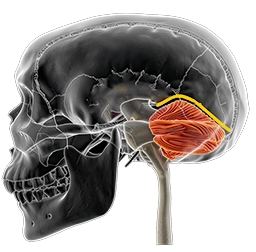
The cerebellum [4, 54] is an organ of the central nervous system located directly behind the brainstem. Together with the brainstem, it occupies the posterior cranial fossa [32, 43, 45] below the tentorium cerebelli [38].
It is attached to the brainstem by three pairs of cerebellar peduncles [43] : superior, inferior, and middle.
The cerebellum contributes primarily to balance and motor coordination [53]. The concentric grooves that mark its surface give it a foliated appearance.
The cerebellum is divided into three main lobes: anterior, posterior, and flocculonodular [35, 54].
These lobes are further subdivided into ten lobules by secondary fissures [4, 43].
The cerebellum is described as having a central (median) region, the cerebellar vermis [55, 56] , and three pairs of deep nuclei: dentate, interposed, and fastigial [38, 54, 57].
The cerebellum shares many similarities with the cerebrum: it also has a peripheral cortex [3, 32, 75] and deep gray nuclei that contain neuronal cell bodies. It has two cerebellar hemispheres [157] : right and left, as well as several fissures that delineate lobes.
The fissures of the cerebellum are deeper [130] than those of the cerebrum, this vastly increases the surface area of the cerebellar cortex, estimated to be 75% of that of the cerebral cortex [4].
Comments